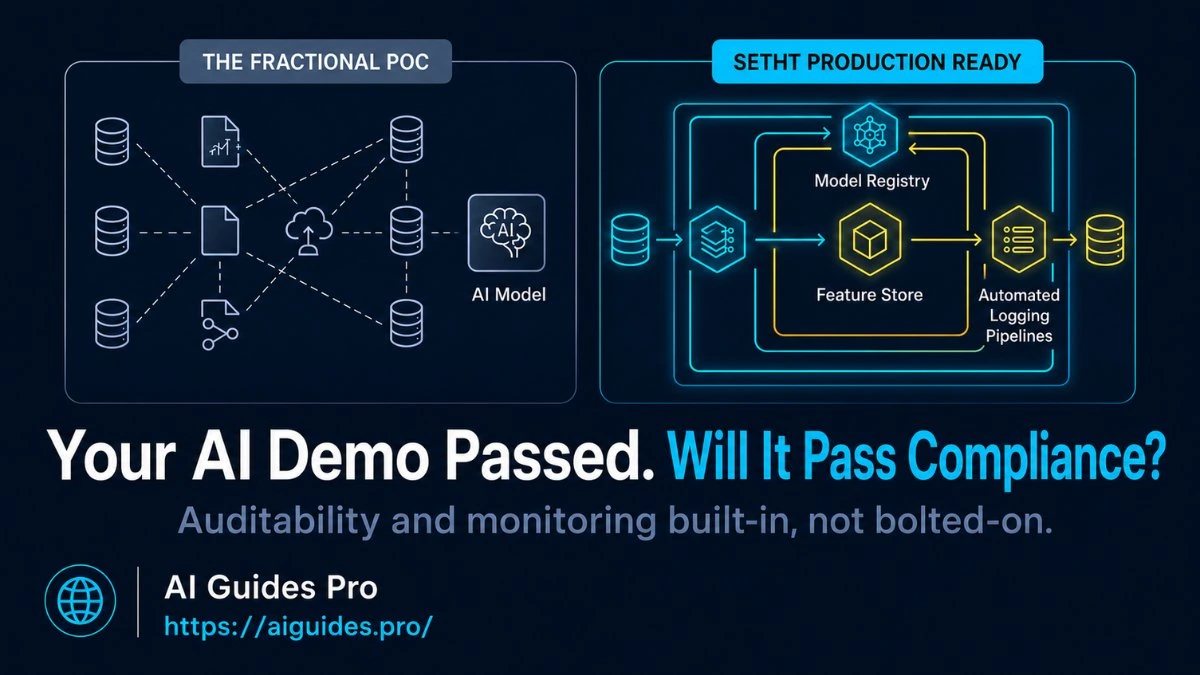

The demo works. The stakeholders are impressed. The POC report lands clean and on time. Then, six weeks later, the enterprise quietly hands the production deployment to someone else.
This is the most common failure mode in AI consulting right now. Dev shops win proof-of-concept work because they move fast and ship something that looks good in a meeting. They lose the production contract because they built the model without building the infrastructure around it.
The compliance team asks three questions, nobody has answers, and a larger firm walks in with a different proposal.
The gap isn’t technical skill. It’s scope. And most dev shops don’t even know what they’re not delivering.
The POC-To-Production Gap Is An Infrastructure Gap
A POC asks one question: does this approach produce useful output? A production deployment asks a completely different set of questions.
Can you explain why the model made that decision? Is every prompt and response logged with a timestamp and user ID? Where does the training data live, and how was it licensed? What happens when the model drifts after a fine-tune? Who gets paged at 2am when the pipeline breaks?
None of those questions are about accuracy. They’re about auditability, observability, and operational ownership. Dev shops that win POCs but lose production deals typically answer zero of them during the engagement scope.
The enterprise buyer isn’t rejecting the model. They’re rejecting the delivery.
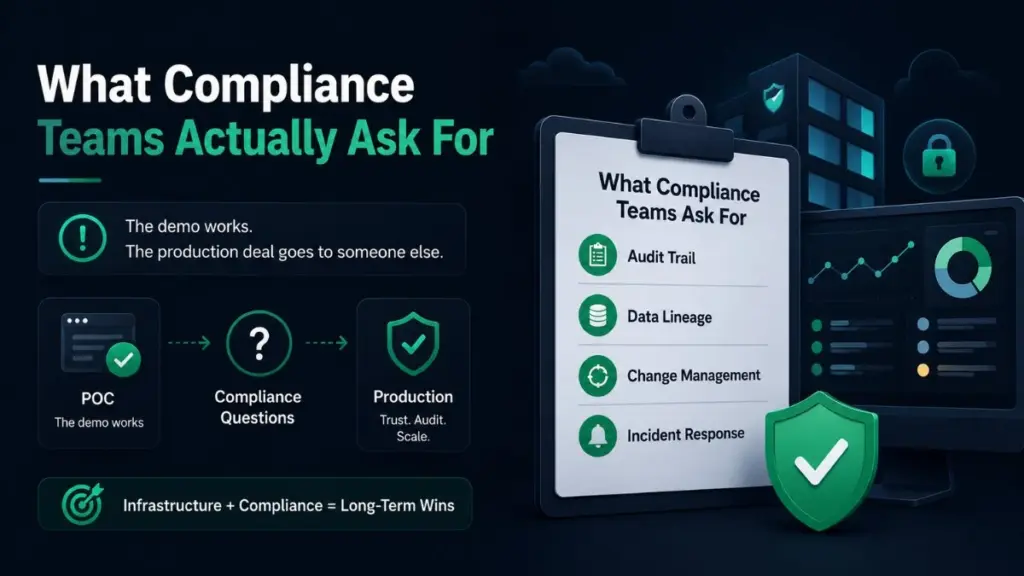
What Compliance Teams Actually Ask For
Most AI consultants walk into an enterprise engagement optimizing for F1 score. The compliance team doesn’t know what F1 score means and doesn’t care.
Here’s what they actually ask for:
- Audit trail
Every inference logged with input, output, model version, timestamp, and user context. Not for debugging. For the SOC2 auditor in six months.
- Data lineage
Where did the training data come from? Is it PII-adjacent? How was consent handled? Can you produce that documentation on a two-week notice?
- Change management
When the model is retrained or the prompt changes, what’s the review process? Who approves it? Is it tracked in version control?
- Incident response
When the model produces a harmful or incorrect output, what’s the remediation path? Who is the escalation contact?
None of this appears in a typical AI consulting proposal. It lives in the contract addenda, the security questionnaire, and the IT risk review that happens after the demo. By the time those questions surface, the dev shop is already behind.
The fix isn’t a compliance tool bolted on at the end. It’s a data foundation that makes compliance reporting a byproduct of operations rather than a separate workstream.
Also Read: The Gap Between ‘AI-Powered’ On The Homepage and AI In Production
The Unglamorous Infrastructure Nobody Scopes
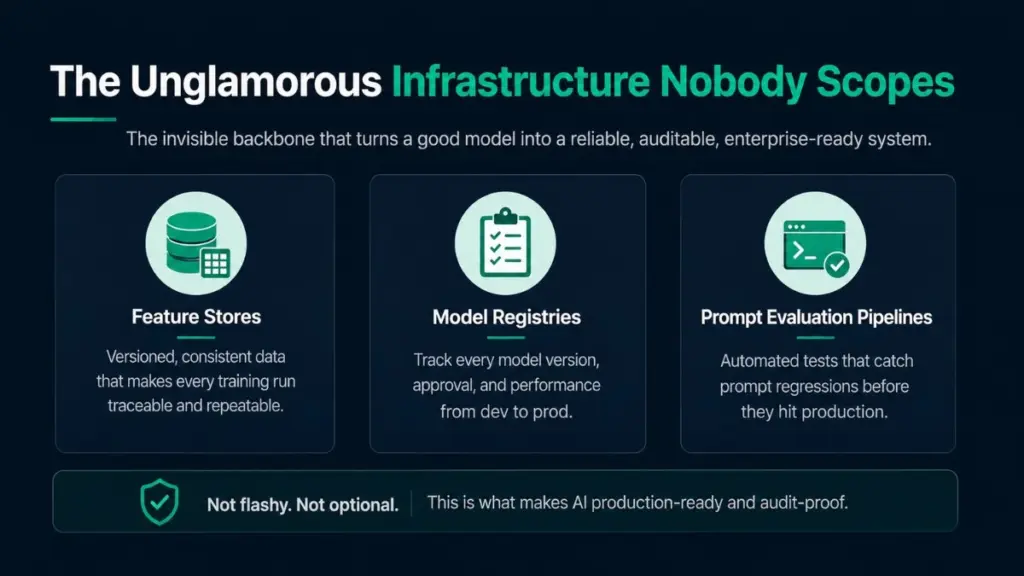
Feature stores, model registries, and prompt evaluation pipelines aren’t exciting. They don’t make for good demo screenshots. But they’re what separates a 90-day POC from a three-year production contract.
- Feature stores
Feature stores formalize how data gets prepared before it reaches the model. Without one, every retraining run is a manual process with undocumented assumptions baked in. With one, the enterprise has a versioned, auditable record of exactly what data shaped each model version.
- Model registries
Model registries track which version is deployed, when it was deployed, who approved it, and what its evaluation metrics were at time of release. A Fortune 100 company running AI in a regulated environment cannot promote a model to production without this. Most dev shop engagements don’t include it.
- Prompt evaluation pipelines
Prompt evaluation pipelines matter especially for LLM-based systems. Prompts change. When they do, there needs to be a repeatable test suite that catches regressions before they reach production. Not ad-hoc spot checks. A structured, automated evaluation that runs on every change.
These aren’t nice-to-haves. They’re table stakes for any enterprise environment that needs to explain its AI decisions to an auditor, a regulator, or a board.
Build The Monitoring Before The Model
This is the most counterintuitive shift in how AI engagements should be scoped. Most consultants build the model first, then think about monitoring. Enterprise production requires the opposite.
Start with observability infrastructure. Log ingestion, structured output capture, alerting thresholds, dashboard scaffolding. Before a single training run. Before the first prompt template.
Why? Because retrofitting monitoring onto a system that wasn’t designed for it is expensive and brittle. The data schema, the log format, the model metadata, all of it needs to be consistent from day one.
If the first three months are heads-down on model performance and month four is “now let’s add logging,” the engagement is structurally broken.
The second reason is credibility. Walking into a compliance review with monitoring already live, with dashboards showing inference latency and error rates and model version history, changes the conversation. It signals that the team understands production, not just research.
How To Scope An Engagement That Doesn’t End At The Demo
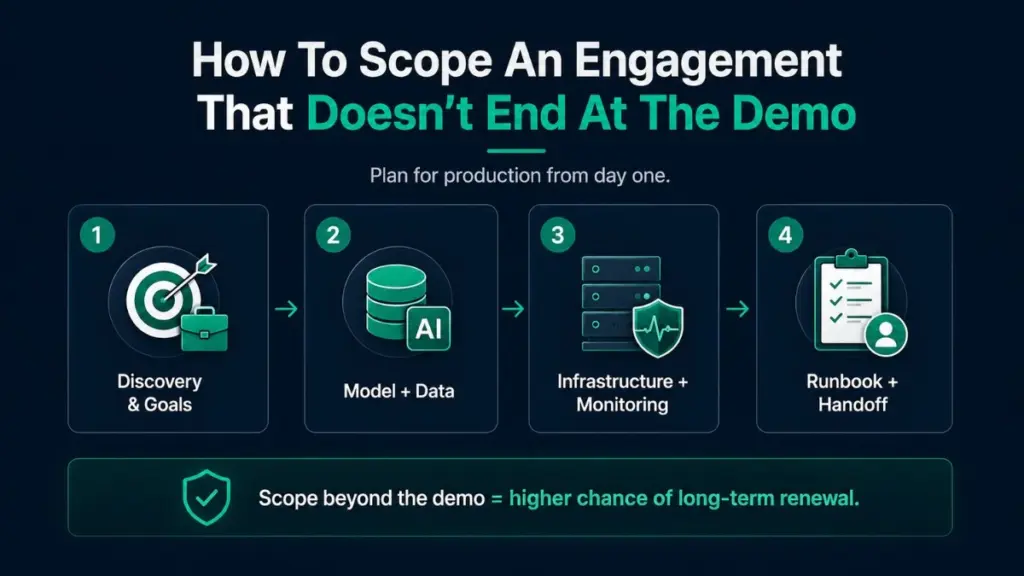
The engagement architecture matters as much as the technical approach. Here’s what a production-ready AI consulting scope looks like versus a POC scope:
- A standard POC scope includes: data exploration, model selection, prompt or fine-tune iteration, accuracy benchmarking, demo delivery.
- A production-ready scope adds: infrastructure design, feature store setup, model registry configuration, logging and observability pipeline, evaluation harness, compliance documentation, runbook and escalation path, handoff to internal engineering.
That second list roughly doubles the engagement length and cost. It also roughly doubles the probability that the client renews. Clients don’t churn on good infrastructure.
The conversation with the client has to be direct. The question to ask is: “In six months, will this need to pass a SOC2 audit or a regulatory review?” If the answer is yes or maybe, scope the infrastructure now. It’s cheaper than going back.
The Firms That Will Win This Market
Enterprise AI spend is not going to the shops with the best model performance. It’s going to the shops that can answer the compliance team’s questions, hand off to internal engineering with documentation that doesn’t require a decoder ring, and operate in the part of the stack that IT risk management recognizes.
That’s a solvable problem. It requires expanding what goes into scope, building the unglamorous infrastructure alongside the model, and treating “this system will be SOC2-auditable” as a first-class project requirement rather than someone else’s problem.
The dev shops that figure this out will win deals they’ve been losing for the last two years.
Conclusion
Winning in enterprise AI is not about being the best at building models. It’s about being the one who thought about what happens after the model goes live.
The compliance questions are coming. The audit trail question is coming. The “how do we retrain this safely” question is coming.
Scope for them now, or lose the renewal later.
The strongest AI partners don’t just deliver working models. They deliver AI systems the business can trust and operate. That’s what turns a successful demo into a long-term engagement.

Add your first comment to this post