

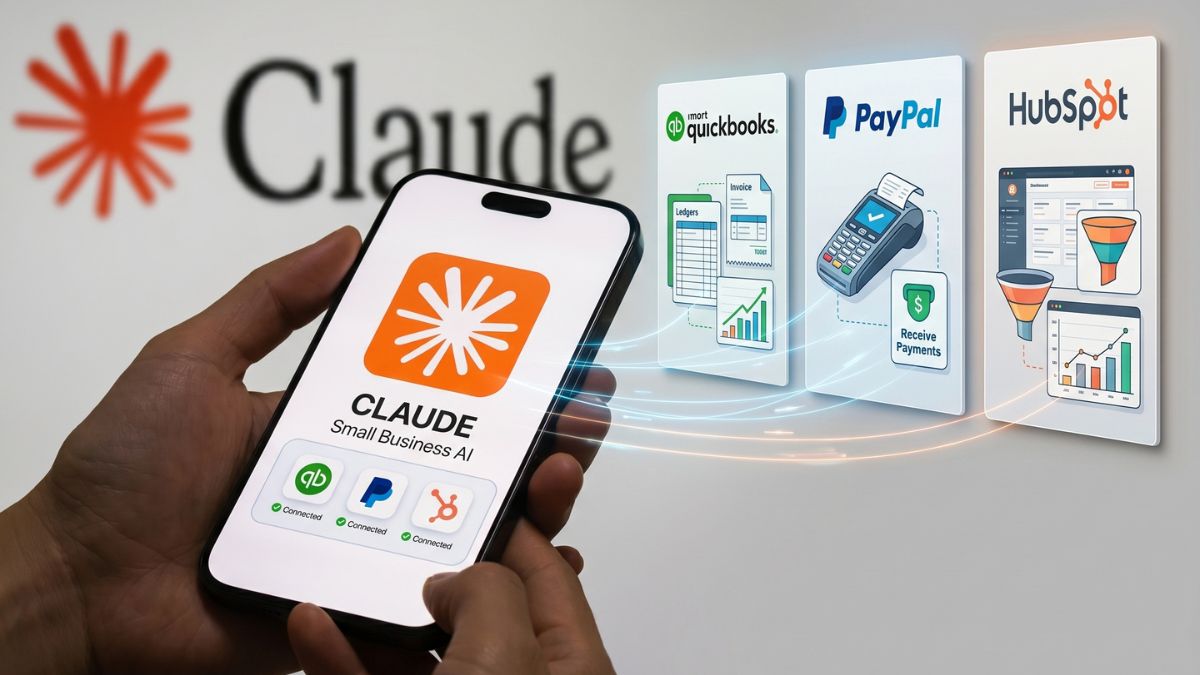

Anthropic has launched “Claude for Small Business,” a new package built for smaller teams that want practical AI tools inside the apps they already use.
The launch targets a market that many AI companies have struggled to reach so far. While large enterprises moved quickly into AI adoption, smaller businesses often stayed cautious due to cost concerns, security worries, and lack of training.
Anthropic says the new offering connects Claude directly with platforms including QuickBooks, PayPal, HubSpot, Canva, DocuSign, Google Workspace, and Microsoft 365.
The company introduced the product on May 13 as part of its broader enterprise software expansion.
Claude Works Inside Existing Business Tools
Anthropic says users can activate Claude through “Claude Cowork” and connect the software tools they already depend on daily.
Instead of only chatting with AI in a separate window, businesses can run workflows tied directly to payroll, invoices, bookkeeping, sales campaigns, and customer support tasks.
According to the company, every workflow still requires human approval before anything gets posted, sent, or paid.
The launch includes 15 ready-made workflows covering finance, operations, sales, HR, marketing, and customer service.
Some examples include:
- Payroll planning using QuickBooks and PayPal data
- Reconciling monthly books and generating reports
- Drafting marketing campaigns with HubSpot and Canva
- Reviewing contracts through DocuSign
- Organizing tax-season paperwork
- Tracking sales pipeline movement
Anthropic says the workflows were built after speaking with small business owners about repetitive tasks that consume time every week.
Anthropic Wants To Reach Smaller Teams Left Out Of The AI Boom
According to Anthropic, small businesses represent nearly half of the U.S. economy, but many still have not fully adopted AI tools.
Lina Ochman, Anthropic’s head of SMB, told Axios that most software products have historically focused on large enterprises or venture-backed startups instead of smaller local businesses.
She pointed to companies like HVAC services, landscaping firms, and real estate brokerages as examples of businesses that know AI could help them but struggle to apply it in useful ways.
Anthropic also said security remains one of the biggest concerns among smaller companies.
The company claims existing account permissions stay in place, meaning employees can only access information already available to them through connected platforms.
Anthropic also says customer data is not used for model training by default on Team and Enterprise plans.
Free AI Training and Small Business Tour
Alongside the product launch, Anthropic announced a free online course called “AI Fluency for Small Business.”
The course was created in partnership with PayPal and includes lessons from business owners already using AI in daily operations.
Topics include identifying tasks suitable for AI, using automation responsibly, and building workflows safely.
Anthropic is also launching a 10-city SMB tour beginning May 14 in Chicago.
The company plans to host free half-day workshops for local business owners in cities including Dallas, Baltimore, San Jose, and Indianapolis.
Attendees will receive a one-month Claude Max subscription during the training sessions.
Anthropic Continues Enterprise Expansion
The launch comes as Anthropic pushes deeper into enterprise AI software.
Earlier this month, the company introduced Claude for Financial Services and also expanded its legal-focused AI tools.
Anthropic’s growth has also increased pressure on traditional software companies. Investors have raised concerns that AI firms could replace parts of the SaaS market if older platforms fail to adapt quickly enough.
Last week, Dario Amodei warned that some SaaS companies could “go bankrupt” if they fail to respond to the AI shift.
Anthropic says its annualized revenue run rate recently passed $30 billion, up sharply from last year, while the number of customers spending more than $1 million annually has also doubled in recent months.




Add your first comment to this post